
Orchestrate LLM inference
across your entire fleet.
The open-source inference orchestration layer. Engine-agnostic, KV-aware, and bare-metal-first. Built in Rust, it runs the same way on a few DGX Sparks, AMD boxes, or Mac Studios on your desk as on a Kubernetes or cloud fleet — one curl install, six binaries.
Overview
The inference orchestration layer
Cognitora doesn't replace your inference engine. It coordinates multiple engines into a unified, distributed cluster. A drop-in alternative to orchestrators like NVIDIA Dynamo, with broader engine coverage (llama.cpp, Apple MLX, any OpenAI-compatible server), bare-metal-first deployment, and energy-aware scheduling. No Python control plane required.
Sub-millisecond routing
Sequence-chained BLAKE3 digests with longest-prefix overlap. Under 500µs per routing decision.
Engine-agnostic
Orchestrates vLLM, SGLang, llama.cpp, Apple MLX (mlx-lm), a TRT-LLM spawn driver (trtllm-serve; no default recipe or GPU E2E gate yet), and the first-party cgn-infer engine through a single OpenAI-compatible gateway.
Production-hardened
mTLS everywhere. Cosign-verified releases. OIDC, API-key, and RBAC out of the box.
Bare metal to fleet
Start on one node with systemd and six static binaries. Federation via QUIC when you outgrow a single rack.
Platform
Modular by design
Each component is independently deployable. Install six static binaries on bare metal with systemd, or add the operator when you need Kubernetes.
cgn-routerKV-aware request router
OpenAI-compatible gateway. BLAKE3 sequence digests + longest-prefix overlap from agent heartbeat claims (live cgn-kvcached queries on the roadmap). Disaggregates prefill from decode.
Learn morecgn-agentEngine supervisor
Per-node agent driving any OpenAI HTTP surface. Built-in drivers for vLLM, SGLang, llama.cpp, MLX, the native cgn-infer engine, and more. NVML telemetry, KV handoff via NixlConnector, multi-engine clusters.
Learn morecgn-kvcachedMulti-tier KV cache
RAM/SSD tiered cache behind engine-owned GPU HBM, with cross-node QUIC fetch. Pluggable offload: nixl, lmcache (in-process or LMCache MP server), hicache, or kvbm.
Learn morecgn-metricsPower-aware telemetry
Prometheus aggregator with Redfish and NVML power telemetry. Power-aware routing deprioritizes thermally stressed nodes.
Learn morecgn-ctlAdmin CLI
Cluster bring-up, model deploys, traffic shaping, and debugging on bare metal. Optional Helm charts when you deploy on Kubernetes.
Learn morecgn-operatorKubernetes operator (optional)
kube-rs operator with CRDs for InferenceCluster, ModelPool, and RoutingPolicy. Add when you need declarative rollouts on Kubernetes — not required for bare-metal installs.
Learn morecgn-inferpreviewNative inference engine
First-party GGUF engine on Candle (CPU/Metal/CUDA). Runs models directly, with no external server, behind the same OpenAI HTTP surface. Continuous batching and layer-pipeline distribution.
Learn moreFeatures
From a local AI cluster to a datacenter fleet
KV-Aware Routing
Sequence-chained BLAKE3 digests + longest-prefix overlap from agent heartbeat claims eliminate redundant prefill. Completion-confirmed cache claims keep the index honest; live cgn-kvcached overlap queries are on the roadmap.
Tool Calling & Structured Output
tools, tool_choice, and response_format pass through to the engine — streaming tool-call deltas included.
Multimodal Inputs
OpenAI image content parts flow straight to vision-capable engines. Prefix hashing stays text-only.
Prefill/Decode Split
Separate replica pools via NixlConnector handoff. Tune hardware per phase.
Multi-Tier KV Cache
RAM (DashMap), SSD (RocksDB), and cross-node QUIC peer fetch.
Energy-Aware Scheduling
Redfish + NVML (rocm-smi on AMD) power telemetry in the routing score, with soft per-node watt caps. Closed-loop autoscaler drains hot nodes; SLA planner scales decode replicas from queue-depth SLOs.
Cross-Cluster Federation
Router forwards to the lowest-latency reachable peer cluster when no local node serves a model. KV cache peers via QUIC.
Gossip Discovery — No etcd
state_backend = gossip forms a UDP scuttlebutt mesh with phi-accrual failure detection. Multi-node clusters with zero external services.
Multi-Model Cascade
SLM→LLM confidence gating on buffered and streaming requests. Save costs, preserve quality.
Pluggable KV Offload
One TOML knob: none, nixl, lmcache (in-process or a node-local MP server), hicache, or kvbm.
Engine-Agnostic Agent
Spawns and supervises vLLM, SGLang, llama.cpp, MLX, a TRT-LLM spawn driver (trtllm-serve; no default recipe or GPU E2E gate yet), or any OpenAI-compatible server — with live queue/KV telemetry feeding the router.
Apple Silicon (MLX)
engine.kind = mlx spawns mlx-lm’s OpenAI-compatible server. Example: examples/apple-mlx/.
Cluster Dashboard
Standalone zero-dependency web dashboard: live req/s, tokens/s, latency and TTFT percentiles, per-node status, KV utilization, power, and J/token — straight from the Prometheus endpoints.
Native Engine (cgn-infer)
First-party GGUF engine on Candle — run models directly, no external server. engine.kind = cgn_infer. Preview.
Observability
See the whole fleet at a glance
A standalone, zero-dependency dashboard ships in the repo: one static HTML file that reads the Prometheus /metrics endpoints directly. Live requests/s, tokens/s, latency and TTFT percentiles, queue depth, per-node status, KV-cache utilization, fleet power, and energy per token. No Grafana, no backend, nothing to install.
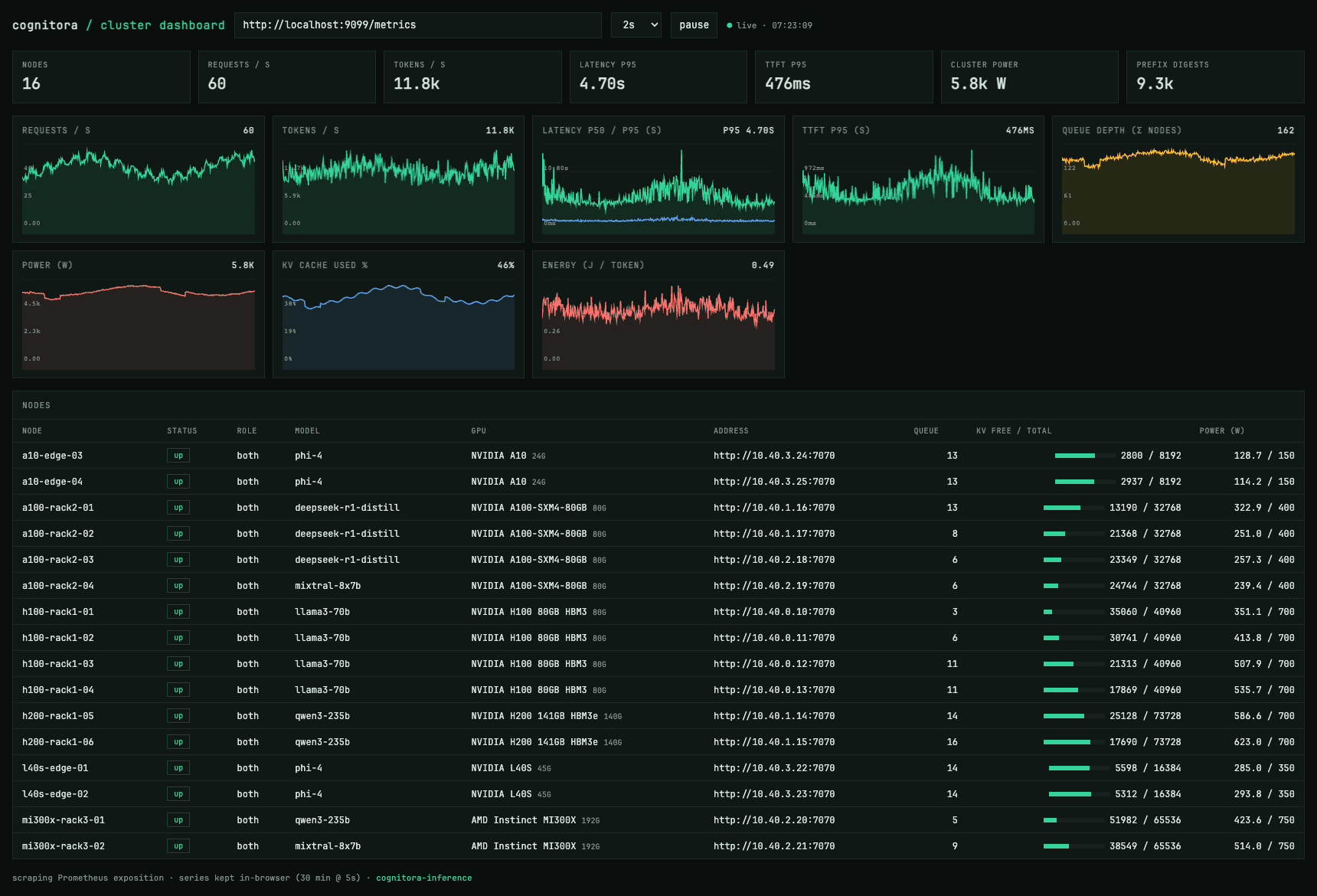
A 16-node mixed fleet (H100, H200, A100, MI300X, L40S, A10) serving five models under load.
Compatibility
Engine support matrix
Any engine exposing the OpenAI HTTP surface. Feature depth varies by backend. TRT-LLM is a spawn driver (trtllm-serve) with no default recipe or GPU E2E gate yet.
| Feature | vLLM | SGLang | llama.cpp | MLX | TRT-LLM | cgn-inferpreview | OpenAI |
|---|---|---|---|---|---|---|---|
| OpenAI HTTP gateway | |||||||
| KV-aware routing | |||||||
| Prefill/decode disaggregate | — | — | — | — | |||
| KV offload — LMCache | |||||||
| KV offload — LMCache MP | |||||||
| KV offload — HiCache | |||||||
| KV offload — KVBM | |||||||
| Multi-tier KV (RAM/SSD) | |||||||
| Multi-model cascade | |||||||
| Energy-aware admission |
wired through config, awaiting upstream support. LMCache MP is the standalone lmcache server plus LMCacheMPConnector (vLLM). SGLang uses --enable-lmcache. · preview = cgn-infer, the experimental first-party native engine (Llama-family GGUF)
Architecture
Disaggregated by design
Prefill and decode on separate pools. KV-aware routing places requests where caches live. Internal gRPC with mTLS everywhere.
Bare Metal
systemd on Linux
Kubernetes
Helm + operator CRDs
Cloud
Terraform: AWS, GCP, Azure, Hetzner
Local Dev
Docker, Ollama, MLX on macOS
Use Cases
From a single GPU rack to fleet orchestration
Apple Silicon & Edge
Run the same router stack locally with MLX (mlx-lm): the agent spawns an OpenAI-compatible server on Apple Silicon while KV-aware routing stays consistent.
Reasoning Models
MoE and chain-of-thought workloads benefit from disaggregated prefill/decode. Split compute phases across specialized pools.
Bare-Metal GPU Racks
One curl install, six static binaries, systemd units. Run Llama on a DGX Spark or a mixed AMD/NVIDIA rack without Kubernetes.
AI Agents
Agent workloads reuse context heavily. KV-aware routing lands follow-ups where the prefix cache lives.
Code Generation
Large repo contexts cached across RAM, SSD, and peer nodes. Hot contexts stay resident, cold ones page transparently.
Cost-Optimized Serving
SLM→LLM cascade gates on log-probability. Cut costs on straightforward queries without sacrificing quality.
vs NVIDIA Dynamo
Positioning
Same orchestration shape, different runtime and deployment surface. Cognitora leads on heterogeneous, energy-aware, ops-light inference — not NVL72 scale.
Bare-metal first
One curl install, six static binaries, systemd units. Kubernetes and Terraform are optional targets, not prerequisites.
Engine breadth
vLLM, SGLang, llama.cpp, MLX, OpenAI-compat, and a TRT-LLM spawn driver — mixed engines in one cluster.
Energy-aware routing
Redfish + NVML power telemetry in the routing score. Soft watt caps and autoscaler drain hints.
Heterogeneous fleets
Per-model GPU constraints route 70B off the L40S without separate deployments per hardware class.
Where Dynamo leads today
- Disaggregated multimodal & video pipelines
- Native KVBM tiered block manager (G1–G4)
- ModelExpress GPU-to-GPU weight streaming
- Grove NVL72 topology-aware gang scheduling
- In-flight request migration
- AIConfigurator deployment search
Credibility gaps we're closing (v0.5)
Router ↔ cgn-kvcached overlap
local heartbeat scoring today
In-flight migration
pre-token retry only
Multi-node GPU E2E
outside default CI
RDMA transport
stub behind feature gate
Performance
CI-gated targets
Every merge to main is gated on these numbers. Harnesses in the repo.
Routing decision
< 500µs
per vCPU, CI-gated
HTTP overhead
< 3ms
p99 vs direct engine
Warm cache hit
< 200µs
RAM tier lookup
Cold cache hit
< 5ms
SSD/RocksDB tier
Cross-node fetch
< 12ms
1 MiB, QUIC, 10 GbE
Cache hit ratio
≥ 55%
representative traces
Energy efficiency
1.4×
vs round-robin
Model bring-up
< 30s
using recipes
Recipes
Production deployment profiles
model/engine/topology/: a 3-line up.sh, serving in <30s.
| Model | Engine | Topology |
|---|---|---|
| Llama 3.2 3B (MLX) | MLX (mlx-lm) | Apple Silicon example |
| Llama-3.1 8B | vLLM | 1×A100 aggregated |
| vLLM | 1×A100 disaggregated | |
| SGLang | 1×A100 | |
| vLLM + LMCache | 1×A100 in-process | |
| vLLM + LMCache MP | 1×A100 node-local server | |
| cgn-infer | Native GGUF single-node | |
| Llama-3.3 70B FP8 | vLLM | TP=4 multi-GPU |
| Qwen3-7B | vLLM | 1×GPU |
| SGLang | 1×GPU | |
| DeepSeek-v4-Flash | vLLM | Multi-GPU |
| SGLang | Multi-GPU |
$ bash recipes/llama3-8b/vllm/agg/up.shQuickstart
One command to install
curl -fsSL https://inference.cognitora.dev/install | sh# prebuilt binaries (x86_64 / aarch64; default = latest GitHub release)
# inference.cognitora.dev/install redirects to deploy/installer/install.sh on GitHub
curl -fsSL https://inference.cognitora.dev/install | sh
# pin version / prefix: vars apply to the shell running install.sh (see deploy/installer/install.sh)
curl -fsSL https://inference.cognitora.dev/install | CGN_VERSION=v0.9.2 sh
curl -fsSL https://inference.cognitora.dev/install | CGN_PREFIX=$HOME/.local sh
# verify
cgn-ctl versioncurl http://localhost:8080/v1/chat/completions \
-H "Content-Type: application/json" \
-d '{"model":"meta-llama/Llama-3.1-8B-Instruct","messages":[{"role":"user","content":"Hello!"}],"stream":true}'Community
Built in the open
Contribute
Issues, PRs, design discussions. CLA-free.
OpenDiscussions
Architecture proposals, deployment questions, roadmap.
OpenDocs
Guides, CRD references, and runbooks, served live from GitHub.
OpenReleases
Changelogs, migration notes. Cosign-verified artifacts.
OpenReady to deploy?
Star the repo, follow the quickstart, bring distributed inference to your fleet.